Guides & Advice
Crib vs Bassinet vs Moses Basket: Newborn Sleep Choices


Few decisions feel as loaded as choosing where your newborn will sleep. The good news is that the crib vs bassinet question (and where a Moses basket fits in) is more straightforward than the marketing suggests once you understand what each one is actually built to do. This guide walks you through the differences in plain terms, so you can pick the right first bed for your baby and your home.
Before anything else, remember that any safe sleep space is only as safe as how you use it. The UK’s leading authorities are clear and consistent, so we’ll point you to The Lullaby Trust safer sleep advice and the NHS guidance on reducing the risk of SIDS throughout. Read both fully before you buy.
Crib vs bassinet vs Moses basket: what’s the difference?
The three terms get used loosely, and UK and US naming conventions don’t always agree, so let’s define them as parents typically encounter them here.
Moses basket
A lightweight, handled basket (traditionally woven palm, wicker or corn husk, sometimes fabric) with a thin, firm mattress. It’s the most portable option, easy to carry room to room, and has a cosy, snug footprint that many newborns settle in well. The trade-off is lifespan: most babies outgrow a Moses basket by around three to four months, or sooner once they can roll or push up.
Bassinet
In UK usage a bassinet usually means a small, raised sleeper, often on a stand or wheels, sometimes attached to a pushchair chassis as a carrycot. Like a Moses basket it’s compact and designed for the early newborn months, but it tends to be sturdier and raised to a more convenient height. Bedside (or “co-sleeper”) cribs that drop down one side to sit flush against your bed sit in this same short-term category.
Crib (and cot)
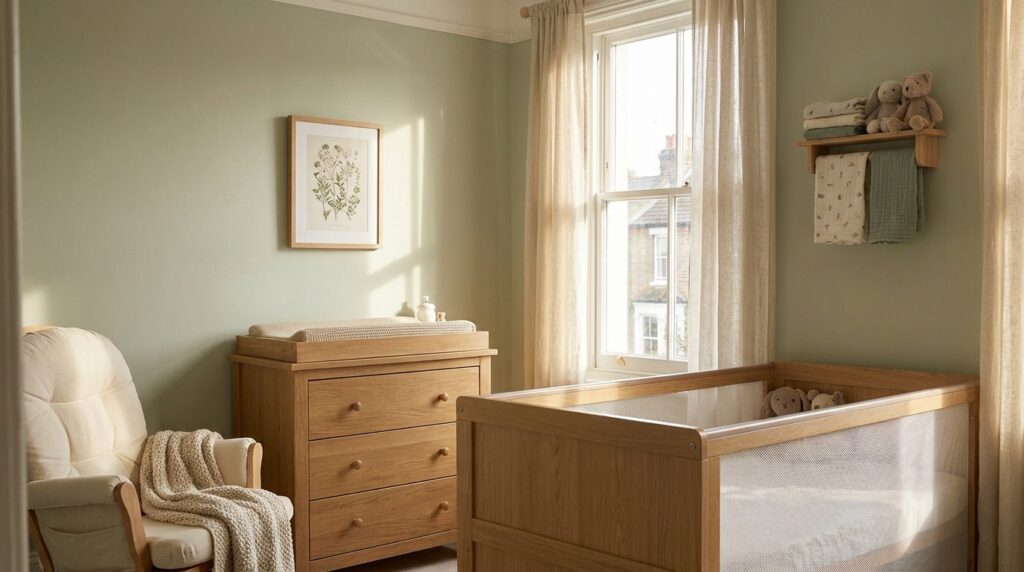
This is the long-haul sleep space. A crib is a fixed-frame bed with high slatted sides; in the UK a full-size version is usually called a cot, and a “cot bed” converts into a toddler bed later. Many modern designs are convertible, growing with your child across several stages, which is where the real value lies.
How to choose the right newborn sleep space
Rather than asking which product is “best”, ask which fits your circumstances. Weigh up these factors:
- Lifespan: A Moses basket or bassinet lasts months; a convertible crib can last years.
- Space: Tight bedrooms favour a bassinet or bedside crib; a nursery has room for a full cot.
- Portability: Need baby to nap near you in the day? A Moses basket wins on carry-anywhere convenience.
- Budget over time: A cheap basket plus a later cot can cost more than one good convertible crib.
- Room-sharing: Both The Lullaby Trust and the NHS advise sleeping baby in the same room as you for the first six months, which often makes a compact bedside option appealing first.
Mattress and bedding basics
Whatever you choose, the mattress must be firm, flat, clean and the correct size for the frame, with no gaps at the edges. Keep the sleep space clear of pillows, duvets, bumpers and soft toys. These are not stylistic preferences; they are core safer-sleep principles set out by the authorities linked above, so always defer to their current advice over any product description.
Comparison at a glance
| Feature | Moses basket | Bassinet / bedside crib | Crib / cot |
|---|---|---|---|
| Typical use | Birth to ~3-4 months | Birth to ~6 months | Birth to toddler (convertible) |
| Portability | Excellent | Moderate | Low (stays put) |
| Footprint | Very small | Small | Larger |
| Longevity / value | Short | Short to medium | Best long-term value |
| Best for | Daytime naps, small rooms | Room-sharing newborns | One purchase that grows with baby |
Our top crib picks for growing families
If you’d rather invest once in something that lasts well beyond the newborn fog, a convertible crib is hard to beat. Here are pieces we rate, spanning budgets and styles.
Best for compact, room-sharing setups
The Stokke Sleepi V3 Mini Crib Bundle (£649) is an elegant choice when space is tight. Its oval shape gives a snug, newborn-friendly feel, it’s on wheels for easy moving between rooms, and it later expands into the larger Sleepi system, so it bridges the bassinet-to-cot gap neatly.
Best value convertible
The dadada Soho 3-in-1 Convertible Crib (£499) brings clean, modern lines and a 3-in-1 conversion (crib to toddler bed to daybed) at the most accessible price point here, ideal if you want longevity without overspending.
Best for a long-term, design-led nursery
For a piece that anchors the room for years, the appleseed Rowan Archtop Convertible Crib (£950) pairs a graceful arched silhouette with convertibility, while the Maxi Cosi Embraced Forms 4-in-1 Convertible Crib (£650) offers four configurations from crib through to a full-size bed for genuinely future-proof value.
Best statement and heirloom options
If you’re furnishing a forever nursery, the Maxi Cosi Reid Headboard Crib (£1,200) makes a soft, upholstered-look focal point, while the Sorelle Eternity 5-in-1 Crib (£799) offers five conversion stages, taking your child from newborn right through to a full double bed.
Practical tips for new parents
- Match the bed to the season of life, not the showroom. A basket for the early weeks plus a convertible crib for the long run is a perfectly sensible combination if budget allows.
- Always buy a new, well-fitting mattress. The Lullaby Trust advises against secondhand mattresses where the history is unknown; a fresh, firm, correctly sized one is non-negotiable.
- Plan the whole room, not just the bed. Lighting, a feeding chair and storage all matter when you’re up at 3am.
- Check assembly and conversion kits. Some convertible cribs need a separately purchased toddler rail or bed frame for later stages, so factor that in.
A good first bed isn’t the most expensive one. It’s the one that fits your space, suits how your family lives, and follows current safer-sleep guidance to the letter.
Further reading
- Safe Sleep for Babies: How to Set Up the Nursery
- How to Build the Perfect Nursery: Furniture Checklist
- Best Nursery Gliders & Rockers for Night Feeds
The bottom line
There’s no single right answer in the crib, bassinet and Moses basket debate, only the right answer for your home, your budget and the months ahead. Many UK families start with a compact bedside option for room-sharing, then move into a convertible crib that carries on for years. Whatever you choose, set it up exactly as the safer-sleep guidance advises and you’ll have done the most important part.
Ready to find the one that grows with your little one? Browse our full collection of cribs, with free UK delivery and free 30-day returns on every order.
Frequently Asked Questions
Is a crib or bassinet better for a newborn?
Both are safe for a newborn when set up correctly. A bassinet or bedside crib suits the early room-sharing months and tight spaces, while a convertible crib lasts far longer and usually offers better long-term value. Many parents use one then the other.
How long can a baby sleep in a Moses basket or bassinet?
Most babies outgrow a Moses basket by around three to four months, and a bassinet by around six months. Move your baby on once they can roll, push up on their hands and knees, or reach the manufacturer's weight or height limit, whichever comes first.
Do I really need both a bassinet and a crib?
Not necessarily. Some families happily use a single full-size cot from birth, while others value the portability and snug feel of a basket for the early weeks before moving to a crib. It comes down to your space, budget and routine.
Where should my newborn sleep at night in the first six months?
The Lullaby Trust and the NHS advise that your baby sleeps in the same room as you, in their own clear, firm, flat sleep space, for the first six months, day and night. Always follow their current guidance over any product claims.
Are convertible cribs worth the money?
For many families, yes. A convertible crib can transform from a newborn crib into a toddler bed and beyond, meaning one purchase can last for years, often working out cheaper than buying separate beds at each stage.